


22-day Natural Namibia self-drive tour
€2.620,00
This is a starting price
- Car hire from Avis including Premium Cover insurance; Premium Damage Waiver (zero liability), Premium Theft Waiver (zero liability), Third party Insurance,
- Public Liability Insurance, unlimited mileage, airport surcharge, tourist tax, VAT (15%), claims handling fee in the event of damage or theft, damage to windows, tyres, wheel covers and rims, sandblasting damage, young driver surcharge and one additional driver.
- 21 nights in accommodation A, B or C as described in the travel proposal or equivalent
- Meals as described
- Activities as described
- Detailed route description and travel information
Travel code AOL 101
Description
In short
A versatile trip with all Highlights Van Namibia. During the trip, a visit will be made to the Kalahari Desert, the Fish River Canyon, the wild horses at Austria and the red dunes of the Sossusvlei.
German influences can be seen in the coastal town. Swakopmund a brilliant rotoschilderingen been Twyfelfontein. Naturally, a visit to the Etosha National Park and to conclude, cheetahs and the Waterberg Plateau.
An individual self-drive trip with overnight stays in small-scale B&Bs, lodges and guesthouses in unique locations
Individual trip with overnight stays in small B&Bs, lodges and guesthouses in unique locations
Programme
Day 1: Windhoek
Arrival in Namibia and picking up the rental car after clearing customs.
Driving to the guesthouse in Windhoek (with a good set of directions from us, of course).
Rest of the day at leisure to rest from the journey or to explore the centre of Windhoek.
Overnight stay in accommodation of your choice:
A: Londiningi Guesthouse, twin room, bed and breakfast
B: The Elegant guesthouse in a double room on a bed and breakfast basis
C. The Olive All Suite hotel in a double junior suite on a bed and breakfast basis
Windhoek, the capital of Namibia, is known for its German colonial influences which can be seen in Windhoek's streetscape. Although Windhoek is not a global city, there are still a number of interesting historical buildings such as the Christuskirche,
The Alte Feste and Clock Tower. A visit to the Alte Feste and State Museum or the Bushmen Art Museum is also interesting. From Windhoek, you can also visit Daan Viljoen Game Park where you can get acquainted with some of Namibia's wildlife.
Plenty of walking opportunities. Windhoek is the only place in Namibia where (almost) everything is available: good medical facilities, banks, embassies, shops, car parts, etc.
For more information, see: www.londiningi.com – www.the-elegant-collection.com/guest-house – www.theolive-namibia.com
Day 2: Windhoek – Mariental (approx. 260 km)
After breakfast, depart Windhoek and drive south towards the Marienthal area.
Arrival and the rest of the day at your leisure to enjoy the beautiful surroundings, take excursions and take photos.
All three accommodations have a swimming pool and a variety of excursions are offered, such as game drives, sunset drives, a cheetah encounter, mountain biking, and various hiking trails (see the website of your accommodation for more information on these).
Overnight stay in accommodation of your choice:
A: Kalahari Anib Lodge, a standard double room on a bed and breakfast basis
B: Bagatelle Kalahari Game Ranch in a Savannah room on a bed and breakfast and dinner basis
C Bagatelle Game Ranch Boutique Farmhouse in a luxury room on a bed, breakfast, and dinner basis
For more information, see: www.gondwana-collection.com – www.bagatelle-lodge.com – www.bagatelle-lodge.com/farmhouse
Day 3: Mariëntal
A full day to enjoy the surroundings and go on excursions.
Overnight stay in accommodation of your choice:
A: Kalahari Anib Lodge, a standard double room on a bed and breakfast basis
B: Bagatelle Kalahari Game Ranch in a Savannah room on a bed and breakfast and dinner basis
C Bagatelle Game Ranch Boutique Farmhouse in a luxury room on a bed, breakfast, and dinner basis
Day 4: Mariëntal – Fish River Canyon (approx. 450 km)
Depart after breakfast and via Keetmanshoop, where a stop can be made to visit the Quiver Tree Forest, drive to the Fish River Canyon.
Besides lounging by the pool, there are, of course, other activities. Hiking, horse riding, and a flight over the Fish River Canyon are among the possibilities.
The Fish River Canyon, one of the largest canyons in the world, is a breathtaking spectacle of nature. Deep at the bottom of the canyon runs a famous hiking trail (no longer accessible), the Fish River Canyon Trail.
This five-day hike is said to be the toughest in Southern Africa (especially due to the heat), and that's saying something.
A walk on the canyon floor can be made from Ai-Ais but is not recommended during the months of December through to February.
Overnight stay in accommodation of your choice:
A: Cañon Roadhouse in a double room on a bed and breakfast basis
B: Cañon Lodge in a double room on a bed and breakfast basis
C Fish River Lodge in a double luxury room on a bed and breakfast and dinner basis
For more information, see: www.gondwana-collection.com – www.gondwana-collection.com – Fish River Lodge Namibia
Day 5: Fish River Canyon
Day at leisure to explore the Fish River Canyon and its surroundings.
All three accommodations offer excursions, and various places can also be visited privately, such as the Ai-Ais hot springs and the Hobas viewpoint.
Overnight stay in accommodation of your choice:
A: Cañon Village in a double room on a bed and breakfast basis
B: Cañon Lodge in a double room on a bed and breakfast basis
C Fish River Lodge in a double luxury room on a bed and breakfast and dinner basis
Day 6: Fish River Canyon – Aus (approx. 225 km)
Depart from the Fish River Canyon and drive in a north-westerly direction through small villages like Seeheim and Aus en route to today's overnight stop.,
Klein Aus Vista Desert Horse Inn, situated in the Aus mountains and bordering the Namib Naukluft Park and the Sperrgebiet where the Namib Desert Horses roam freely.
Arrive in the afternoon and spend the rest of the afternoon enjoying the stunning surroundings.
It is also possible to visit Lüderitz or the “Ghosttown” Kolmanskop. Of course, keep an eye out while on the road for the Namib Desert Horse.
Overnight stay in accommodation of your choice:
A: Small at Vista Desert Horse Inn in a double room on a bed and breakfast basis
B: Eagles Nest Chalets, double room, bed and breakfast*
C Eagles Nest Chalets, double room, bed and breakfast*
(* Eagles Nest is a 3-star accommodation, but it's situated in a unique environment where there are no 4 or 5-star alternatives.
For more information, see: www.klein-aus-vista.com – www.klein-aus-vista.com/accommodation/eagles-nest-chalets
Day 7: Aus
A full day to explore the surroundings and perhaps take a trip to Kolmanskop (an old mining town, now an uninhabited ghost town/open-air museum), visit Luderitz and of course, search for the wild horses.
Overnight stay in accommodation of your choice:
A: Small at Vista Desert Horse Inn in a double room on a bed and breakfast basis
B: Eagles Nest Chalets, double room, bed and breakfast*
C Eagles Nest Chalets, double room, bed and breakfast*
(* Eagles Nest is a 3-star accommodation, but it's situated in a unique environment where there are no 4 or 5-star alternatives.
Further information:
Gondwana Sperrgebiet Rand Park; (510 km², 3 km west of Aus)
Garub / Wild Horses; (20 km from Gondwana Sperrgebiet Rand Park)
Ghost Town Kolmanskop; (45 minutes from Gondwana Sperrgebiet Game Park)
Aus; (3 km from Gondwana Sperrgebiet Rand Park)
Lüderitz; (1 hour from Aus)
Day 8: Aus - Sesriem (approx. 350 km)
Departing from Aus on time and driving to Sesriem and the famous Sossusvlei.
En route, a stop can be made in Helmeringhausen, a charming little village in the middle of nowhere with a (small) museum and a shop and restaurant.
Arrive in the afternoon; if there is still sufficient time, a visit can be made to Sesriem (sunset). (Here you can also buy your ticket for the following morning straight away so that you can drive straight through in the morning.).
This is because it can get quite busy in the morning as everyone wants to be in the park at sunrise.
Overnight stay in accommodation of your choice:
A: Desert Camp in a double room on a bed and breakfast basis
B: Desert Homestead Lodge, double room, on a bed and breakfast and dinner basis
C Sossusvlei Lodge in a superior double room on a bed and breakfast and dinner basis
For more information, see: www.desertcamp.com – www.deserthomesteadlodge.com – www.sossusvleilodge.com
Sossusvlei, together with Etosha National Park, forms the two main tourist attractions of Namibia.
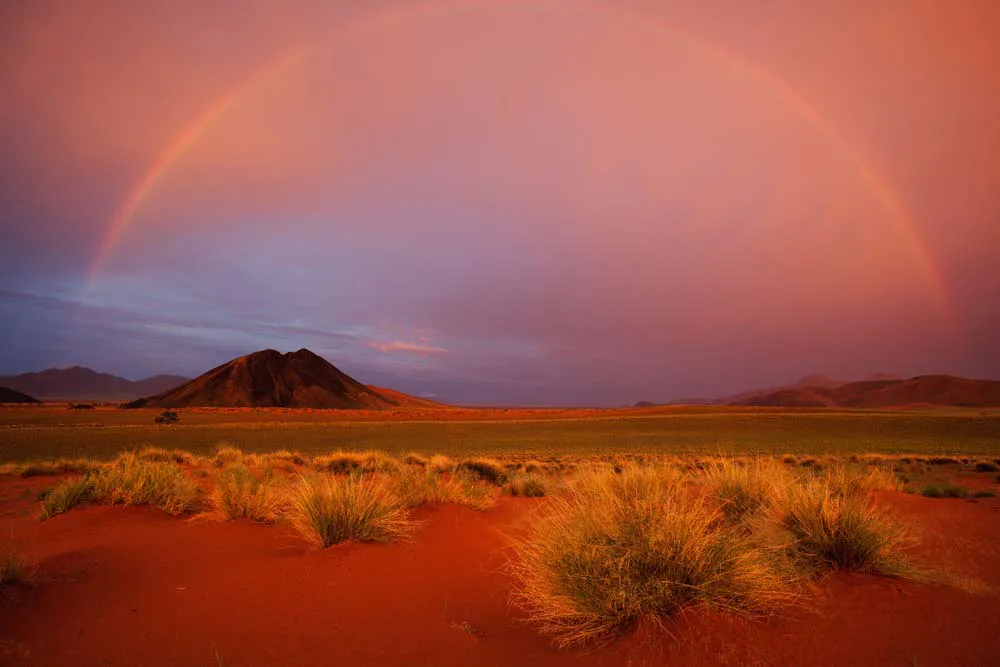
De Sossusvlei is a dry lakebed (which only floods during exceptional rainfall) situated amidst the famous and much-photographed deep-red, steep sand dunes of the Namib Desert.
The vlei is located in the Namib-Naukluft National Park, a vast and extensive area full of similar dunes. The reason Sossusvlei has become so famous is simply because this vlei is so accessible, by local standards at least, as the vlei is located 60km inside the park, with the last 5km only accessible to walkers or 4×4 vehicles.
Access is via the Park Authority office at Sesriem, named so because the nomadic Afrikaner farmers who arrived in this area needed six knotted leather straps/reins (from the ox wagon) to be able to pull buckets of water from the well.
The spectacular dune landscape is very photogenic and, in connection with the beautiful curved shadows on the red dunes, the best time to photograph is early in the morning and/or at sunset.
However, the gates to the office do not open until sunrise; you will first need to purchase a “permit”, and then it is still an hour’s drive to the car park (without stopping), followed by a 5km walk or a 4x4 ride.
You will therefore miss the sunrise itself, but absolutely do not despair, the shadows are certainly still beautiful until around 11:00 AM and again from approx. 3:00 PM onwards (depending on the period in which you are travelling).
En route, there are several well-known stopping places including Sesriem Canyon (accessible directly to the left of the small office), Elim, and Dune 45.
Approximate daily entry fees for Sossusvlei: N$150 per person plus N$ 50 for the car. At the end of the tarmac road there is a car park for standard vehicles; please do not attempt to drive any further without a 4×4, as you are guaranteed to get stuck after just a few minutes.
It's a 5km walk to the vlei, and there are also “shuttle services” in 4x4 vehicles (round trip). You can, of course, also stay at the first parking area, as the dunes are impressive there too.
You may walk anywhere in the area but only ride on marked paths.
Because Sossusvlei can be relatively busy, especially in high season and later in the day, other vleis, such as Hidden Vlei (from the first car park) and Dead Vlei (near the end of the 4x4 track on the left), are becoming increasingly popular.
The last one is perhaps even more beautiful than Sossusvlei. At the end of the 4x4 sand track, there is a spacious area for parking (with acacias). From here, you can walk into Sossusvlei (straight ahead) or Nara Vlei (to the right of Sossusvlei).
The real sport, of course, is to walk up the crest of one of the steep dunes, for a fine view over the vast desert and rows of dunes that remain invisible to those who stay below.
There are toilets at both car parks (without water or paper!). Furthermore, there are no facilities in the park, so fill up with fuel, water and food beforehand if necessary, and also bring a hat and sun cream.
At the Sesriem campsite, there is a camp shop, but it only has a very basic supply (water, cans, no fresh items; sometimes there is bread at the kiosk). Near the entrance, there is a petrol station.
Here, besides refuelling, you can also get sandwiches for lunch and there are computers with internet available.
Day 9: Sesriem
Full day in the Namib-Naukluft National Park with a visit to Dune 45 (known for photos of people walking up a steep dune rim) and of course, a visit to Deadvlei.
Overnight stay in accommodation of your choice:
A: Desert Camp in a double room on a bed and breakfast basis
B: Desert Homestead Lodge, double room, on a bed and breakfast and dinner basis
C Sossusvlei Lodge in a superior double room on a bed and breakfast and dinner basis
Day 10: Sesriem - Swakopmund (approx. 350 km)
Depart from Sesriem and drive via the picturesque Solitaire (what's in a name) and the Kuiseb Canyon to the coastal town of Swakopmund. The Kuiseb Canyon is a magnificent area with beautiful geological vistas.
This area is home to a number of animal species adapted to this harsh landscape, such as the springbok, oryx, ostrich and mountain zebra. The Kuiseb Canyon is a magnificent area with beautiful geological vistas.
Rest of the afternoon at your leisure to explore Swakopmund.
Swakopmund is a provincial-feeling little town with strong German influences, and it's a foraging place for travellers where all sorts of things can be arranged, such as car and camera repairs, doctor's visits, etc.
During the summer holidays, “Windhoekers” come to stay to escape the scorching hot capital. The ocean is mainly suitable for sea anglers as the water (influenced by the South Pole) is too cold for swimming.
In the surrounding area, many active sports can be enjoyed, such as dune surfing, quad biking, horse riding, kayaking with seal excursions, and much more.
The entire area is unique in the world due to the contrast between the dry, empty, and extremely hot desert, right up to the water's edge, in beautiful red and yellow hues, and the ice-cold, azure blue ocean.
It is often misty in this area, the only chance of survival for plants like the Welwitschia Mirabilis, Namibia's best-known plant which can be seen east of Swakopmund.
The plant has only two leaves, which can grow several metres long and lie curled up in the sand. The Welwitschia can live for up to 1000 years! They grow extremely slowly and multiply with difficulty.
Botanists have been studying for decades their still not fully understood ability to survive in almost total drought. It is thought they can live for years on sea mist alone.
To view the Welwitschia, you need a permit from the Swakopmund Tourist Office. The route itself is along the D1991 (from the C28).
Please note: Welwitschia can also be seen in the Petrified Forest, where there is incidentally slightly more water than in this area, namely the northern part of the Namib-Naukluft National Park.
Overnight stay in accommodation of your choice:
A: Sea Breeze guesthouse, double room, bed and breakfast
B: Cornerhouse guesthouse, double room, bed and breakfast
C Desert Breeze in a twin bungalow on a bed and breakfast basis
For more information, see: www.seabreeze.com.na – www.cornerstoneguesthouse.com – www.desertbreezeswakopmund.com
Day 11 - 12: Swakopmund
Full day in and around Swakopmund.
A visit can be made to the centre of Swakopmund, the seal colony at Cape Cross, and various organised excursions can be taken, such as a 4x4 excursion to Sandwich Harbour, a living desert excursion, or a boat trip in search of dolphins and whales.
(www.sandwich-harbour.comBoth recommended to book in advance).
Overnight stay in accommodation of your choice:
A: Sea Breeze guesthouse, double room, bed and breakfast
B: Cornerhouse guesthouse, double room, bed and breakfast
C Desert Breeze in a twin bungalow on a bed and breakfast basis
Day 13: Swakopmund – Twyfelfontein (approx. 325 km)
Depart from Swakopmund and drive via Cape Cross (seal colony), Uis and the Brandberg to Khorixas.
The afternoon is for relaxing at the accommodation. In the morning, you could potentially visit the Cape Cross Seal Colony.
Approximately 46km north of Henties Bay and 114km north of Swakopmund along the C34 is an easily accessible colony of thousands of South African fur seals, the *Arctocephalus pusillus pusillus*.
This fine name should not disguise the fact that the colony is surrounded by a terrible stench of fish and droppings, but it is impressive nonetheless, and after half an hour one gets somewhat used to it.
Depending on the time of year, the colony is estimated to have many tens of thousands of animals that can be seen excellently on the beach and, in particular, in the impressive waves.
You can get within less than 2 metres (a low wall keeps the lumbering animals at bay). There is plenty to see. Wandering youngsters, nursing mothers, fighting fathers protecting their harems (the males often spend months at sea to replenish their depleted fat reserves).
Beware of any jackals and very occasionally hyenas that roam the colony looking for dead babies and fish. Along the edges of the colony, where the “single males” usually hang out, the walls are no longer effective and it's best not to get too close.
Also, don't forget to use the toilet at the entrance office as the toilet on the beach is occupied by seals. The colony is part of a protected area and there is a small entrance fee.
You can also view a copy of the cross here, which was erected in 1485 by the Portuguese Diego Cão, the first European to go so far south on African shores.
The park is officially open from 08:00 to 17:00.
Overnight stay in accommodation of your choice:
A: Damara Mopane Lodge in a twin room with en-suite bathroom on a bed and breakfast basis
B: Vingerklip Lodge in a double room with en-suite bathroom on a bed, breakfast and dinner basis
C Camp Kipwe in a double bungalow on a bed, breakfast and dinner basis
For more information, see: www.gondwana-collection.com – www.vingerklip.com.na – www.kipwe.com
Day 14: Twyfelfontein
Day at leisure to explore the surroundings and visit local sights.
Overnight stay in accommodation of your choice:
A: Damara Mopane Lodge in a twin room with en-suite bathroom on a bed and breakfast basis
B: Vingerklip Lodge in a double room with en-suite bathroom on a bed, breakfast and dinner basis
C Camp Kipwe in a double bungalow on a bed, breakfast and dinner basis
Twyfelfontein rock engravings – at the end of the D3214.
This rocky area is home to one of the largest concentrations of San (Bushman) rock art/engravings in Africa. Here you can see examples of animals, animal tracks, people and geometric motifs drawn (actually scratched) into the rocks.
The panels even depict penguins and seals that were once recorded by the San after distant hunts. Unfortunately, the area can no longer be visited individually, this is to prevent damage and to create much-needed employment.
Upon arrival, you will be provided with a local guide who will lead you on a half-hour or one-hour walk, showcasing a series of clear examples.
The Organ Pipes – along the D3254, another example of Namibia's wondrous and explosive geological history.
Columnar basalt up to 5m high, dolerite, approx. 120 million years old.
Burnt Mountain – also along the D3254, beautiful orange-brown mountain, best visited towards the end of the day when the light is less harsh.
The Petrified Forest (Petrified Forest) – along the C39, approx. 42km west of Khorixas. In this area, you can see petrified tree trunks that arrived here approximately 250 million years ago, probably during great floods from Angola (these types of wood are not found in this part of Africa).
Fossilisation occurred because the trees were covered by new layers of earth/rock for thousands of years. Subsequently, these layers eroded, exposing the fossilised pieces.
You can also see the Welwitschia Mirabilis here, Namibia's most famous plant. The plant has only two leaves, which can grow several metres long and lie curled up in the sand.
The Welwitschia can live for up to 1,000 years! They grow exceptionally slowly and reproduce with difficulty.
Botanists have been studying for decades their still not fully understood ability to survive in almost total drought (the oldest specimens are also found east of Swakopmund, in the middle of the Namib desert).
They think they can live for years on sea mist alone.
Here too, you can only go up the hill with a local guide.
Day 15: Twyfelfontein – Etosha National Park (west) (approx. 325 km)
Depart from Twyfelfontein and drive towards the Etosha National Park area.
Rest of the day at your leisure to go on game drives in Etosha National Park with your own car or to do a guided activity that is
offered via the accommodation (see the website of the respective accommodation for more information on this,
these activities are best booked during the reservation of the trip.
Overnight stay in accommodation of your choice:
A: Etosha Toshari Lodge in a double room with en-suite bathroom on a bed and breakfast basis
B: Eagle Tented Camp in a twin standard safari tent on a bed and breakfast and dinner basis
C Epacha Game Lodge in a twin luxury chalet on a bed, breakfast and dinner basis
(incl. conservation fee for Eagle Tented Camp and Epacha Game Lodge)
For more information, see: www.quiverandconamibia.com/lodges/toshari-lodge/ – www.eagle-tented-lodge.com – www.epachalodge.com
Excluding entrance fees for Etosha, which are currently N$ 150 per person per day and N$ 50 per car per day.
The ETOSHA NATIONAL PARK is one of Africa's best and best-known game parks.
The park covers an area of approximately 23,000 km² (so more than 75km by 300km). The park derives its name from the Etosha Pan itself, a vast, flat, dry lake with a white salt crust over which the brightly shining sun creates enormous mirages.
The pan covers about a quarter of the park and in some places you can drive over it.
After summer downpours, the pan sometimes fills partially with water. What makes Etosha so special are the numerous springs and waterholes along the edge of the Pan, especially on the south side, and the savannah landscape that attracts many grazing herds.
The grazing animals are always followed by hunting animals, and the open plains are an ideal hunting ground, especially for cheetahs and to a lesser extent for lions. In this area, wildlife was teeming at the end of the 19th century. Herds of tens of thousands of springbok were observed.
As everywhere in Africa, the animals were shot in large numbers by European hunters until Dr. F. von Lindequist, Governor of “German South West Africa”, declared Etosha and Kaokaland as a reserve in 1907.
Etosha remains appealing due to the openness of its landscape and the large groups of grazing herds, which often visit the waterholes with many species at once.
It is not unusual to see springbok, kudu, zebra, giraffe and elephants drinking at the same waterhole. There are also many ostriches, jackals and over 340 bird species.
Large cats are also present (especially lions and cheetahs), but in this enormous area, the “cat density” is quite low (for example, compared to Kruger Park in South Africa), and many visitors to Etosha do not see cats.
Nevertheless, it remains a unique and very photogenic park.
Day 16 - 17: Etosha National Park (West)
Days at leisure, including a game drive in Etosha National Park with your own car or organised by the lodge (optional and charged, please see website for more information on activities and game drives).
Overnight stay in accommodation of your choice:
A: Etosha Toshari Lodge in a double room with en-suite bathroom on a bed and breakfast basis
B: Eagle Tented Camp in a twin standard safari tent on a bed and breakfast and dinner basis
C Epacha Game Lodge in a twin luxury chalet on a bed, breakfast and dinner basis
Day 18: Etosha National Park (East) (approx. 170 km)
Depart from the accommodation and drive through Etosha National Park to the eastern side of the park.
On your way, enjoy a game drive through Etosha National Park in your own car. Leave Etosha National Park via the von Lindequist gate and drive to your accommodation.
The rest of the afternoon is at your leisure.
Overnight stay in accommodation of your choice:
A: Onguma Etosha Bush Camp in a twin rondavel on a bed and breakfast and dinner basis
B: Onguma Forest Camp in a standard double Tree House on a bed and breakfast and dinner basis
C Onguma Tented Camp in a double luxury safari tent on a bed and breakfast and dinner basis
The stay at Onguma Tented Camp includes 2 activities per day.
(incl. conservation fee for all accommodation in Onguma Game Reserve)
For more information, see: www.waterbergnamibia.com – www.indongolodge.com – www.okonjima.com
Day 19: Etosha National Park (East)
Full day of game drives in Etosha National Park or organised by the Onguma Game Reserve.
Overnight stay in accommodation of your choice:
A: Onguma Etosha Bush Camp in a twin rondavel on a bed and breakfast and dinner basis
B: Onguma Forest Camp in a twin Bush Suite on a bed and breakfast and dinner basis
C Onguma Tented Camp in a luxury twin safari tent on a bed and breakfast and dinner and drinks basis
The stay at Onguma Tented Camp includes 2 activities per day.
Day 20: Etosha National Park – Waterberg Plateau (approx. 360 km)
After breakfast, depart from Etosha National Park and drive south towards the Waterberg Plateau.
The afternoon is free to visit the nearby Cheeta Conservation Trust, to take a sundowner drive through Waterberg Park,
A nature walk, a visit to “Little Serengeti”, an area that strongly resembles the Serengeti in Tanzania in terms of nature.
Overnight stay in accommodation of your choice:
A: Waterberg guest farm in a double room on a bed and breakfast basis
B: Frans Indongo Lodge, twin room, on a bed and breakfast basis
C Okonjima Plains Camp, a twin view room on a bed & breakfast and dinner basis
Day 21: Waterberg Plateau
Full day for excursions in the surrounding area.
Overnight stay in accommodation of your choice:
A: Waterberg guest farm in a double room on a bed and breakfast basis
B: Frans Indongo Lodge, twin room, on a bed and breakfast basis
C Okonjima Plains Camp, a twin view room on a bed & breakfast and dinner basis
Day 22: Waterberg Plateau - Windhoek (approx. 270 km)
After breakfast, depart from Waterberg Plateau and drive to Windhoek Airport via Okahandja (there's an opportunity to visit a nice souvenir market here).
Return the rental car at Windhoek Airport at the Avis office.
End of arrangement.
Reisom
REISSOM 22-DAY “NATURAL NAMIBIA” SELF-DRIVE TOUR:
- A: £2620 per person (valid from 01-01-2026 to 31-10-2026)
- B: £3,785 per person (valid from 01-01-2026 to 31-10-2026)
- C €7,070 per person (valid from 01-01-2026 to 31-10-2026)
The prices above are based on two travellers. For solo travellers or multiple people, please enquire for pricing.
Prices for departures after 31-10-2026 are not yet available. If you are interested, please send us a message. Contact Form
Flight
The stated travel fee does not include international flights. Of course, we can offer you flights from all airlines affiliated with IATA BSP.
If you are interested, we can send you a price quotation with different options from various companies.
Flight price indication for this trip: Lufthansa from Amsterdam to Windhoek with a stopover in Frankfurt or Munich and return from EUR 1019,- per person including airport tax
Extension or shortening of the trip
If you prefer a longer or shorter stay in Namibia or another country in Africa, that is also possible. A “tailor-made” trip to your personal wishes is, of course, also possible.
If you let us know your travel wishes, we will provide you with a great quote, free of charge and with no obligation.
Changing the route:
This trip is an example of what we can offer you. If you wish to change the trip or route, that is certainly possible. We are happy to adapt the trip to your personal travel wishes.
Another car
If you would prefer a different car (larger or smaller), this is of course possible; the price for this is on application. More information about the different types of cars can be found on our website. www.afrikaonline.nl under the heading car rental.
Departure dates:
Daily
Incl./excl. with this trip
Travel information
Accommodation
This trip is offered with a choice of accommodation. Accommodation A consists of charming guesthouses (2-3 stars), accommodation B comprises more luxurious guesthouses (3-4 stars), and accommodation C features higher-end guesthouses (4-5 stars) with that little something extra.
Naturally, for both categories, accommodations A, B, and C are all situated in special locations. If you wish to combine accommodations A-B-C, we would be happy to make a tailored travel proposal for you.
Rental car
Category B rental car (VW Polo hatchback or similar type with air conditioning) included with option A, a Category C rental car (Toyota Corolla Quest sedan with air conditioning or similar type) (for option B), or Category E car hire (Toyota Urban Cruiser or similar automatic type with air conditioning or similar type) (for option C) including premium cover insurance and unlimited mileage.
To hire a car in Namibia, you must hold a valid international driving licence (available from the ANWB). The deposit of N$ 3,500 for Avis must be paid by credit card.
Drivers under 18 years of age must have held their driving licence for at least 1 year.
Participation
Anyone in good health can participate in this trip.
Child discount
Children under 12 often qualify for a discount. The discount is age-dependent and available upon request.
Visa
If you are in possession of Dutch nationality, you have required a visa for travel to Namibia since 1 April 2025, plus a passport that is valid for at least 6 months upon arrival in Namibia.
If you enter Namibia via Windhoek airport, you can apply for a “visa on arrival” at a special counter there (allow for longer waiting times) or apply for an e-visa up to 90 days before departure via the following link: https://eservices.mhaiss.gov.na/.
There must also be enough blank pages side-by-side in the passport for the required stamps (at least 3). If you hold a nationality other than Dutch, you will need to obtain information from the Namibian Consulate yourself.
AfrikaOnline does not provide visas.
For information, please visit the website www.nederlandwereldwijd.nl/reisadvies/namibie. Should you not have a valid visa, passport and/or travel documents during your trip, the consequences will be for your own account.
If you are travelling with children under 18 years old, you must possess a copy of the International Birth Certificate. If you are travelling as a single parent or simply travelling alone with your minor child, you must also possess a consent form from the other parent.
Please inquire with Afrika Online for comprehensive information on this matter. (subject to change)
Vaccinations
We advise you to obtain information about the required vaccinations for your destination country well in advance of your departure, via a travel clinic, such as www.reisprik.nl, www.dereisdokter.nl, or the GGD.
Vaccination against yellow fever is required if the traveller is entering the country of destination from a risk area or has visited a risk area in the preceding three months. Risk areas include parts of Central and South America and Africa.
Luggage
Suitcase or travel bag with generally a maximum of 23kg per person and 1 piece of hand luggage per person of a maximum of 10kg.
Check your ticket or the airline's website for the correct details and permitted luggage dimensions.
AfrikaOnline.nl – Tel: 070 401 4092
Price subject to change
AfrikaOnline is not bound by errors or mistakes


 Dutch
Dutch  English